open the box.
“AI music” makes radically different creative processes sound like one thing. M² is a way of opening the box: mapping where generative and computational systems participate in making a record — and in bringing it into the world.
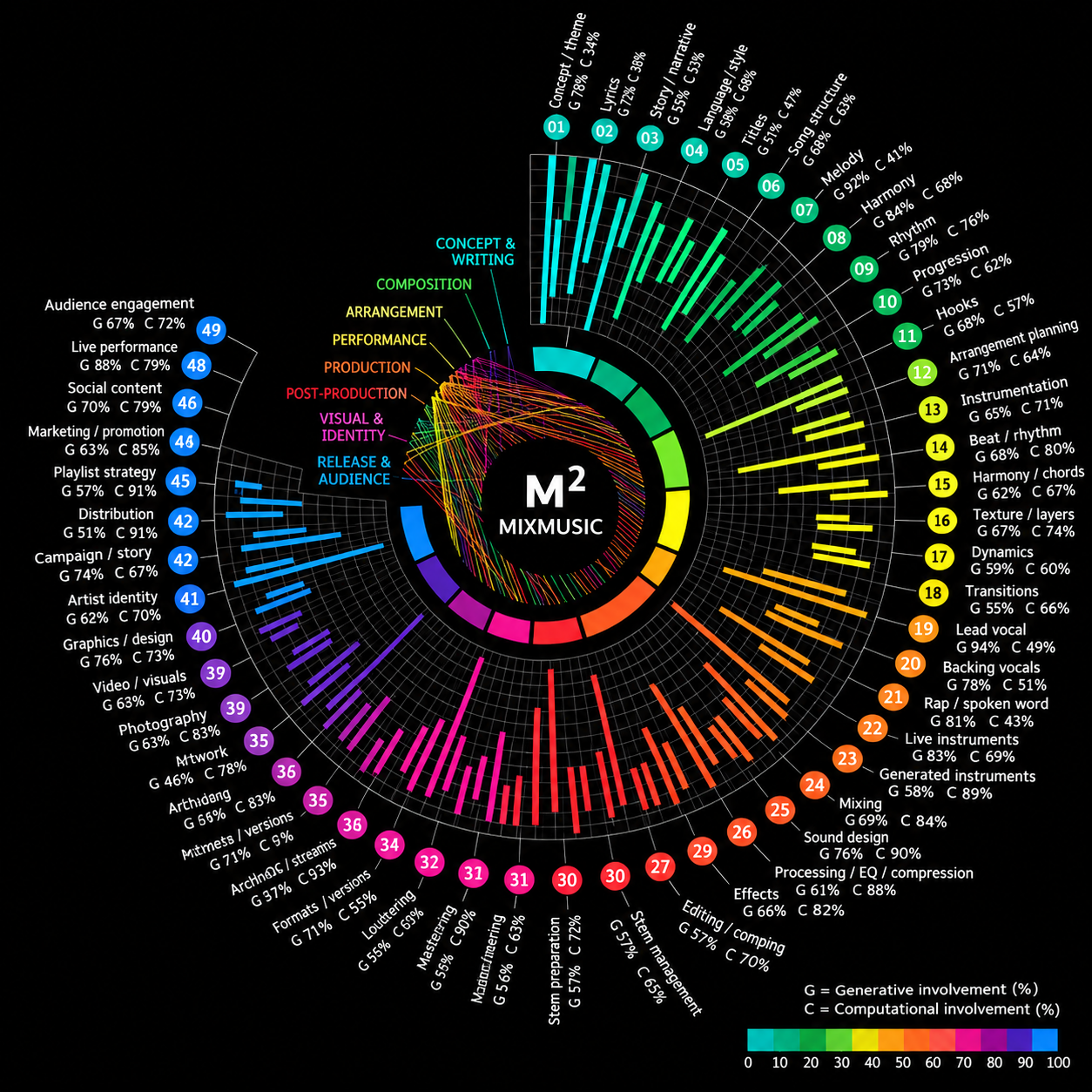
G = generative involvement. C = computational involvement. They are separate measures, not opposite sides of a 100% scale. The figures above are illustrative: the point is the profile, not a claim to scientific precision.
AI music isn't one thing
The same label currently covers radically different creative processes.
MixMusic isn't a genre
M² describes how work is made, not what it sounds like.
The percentage isn't the profile
Two works can show the same overall involvement and still be made in completely different ways.
Generative isn't the opposite of human
Music was computational long before generative AI arrived.
The record is only the centre
For small creator-led operations, music, identity, visuals, release and promotion can be one workflow.
The question is where
Not simply “Was AI used?” but where, how and to what extent?
AI music isn't one thing.
A prompt can produce lyrics, music and a performance. A songwriter can write every word and note, then use a generative system as performer or producer. A conventional recording can contain one generated stem. A musician can move material backwards and forwards between generative systems and a conventional DAW, rewriting, replacing, editing and mixing as they go.
Calling all of those things “AI music” tells us almost nothing about how the record was made. MixMusic starts from the mixture instead.
Generative isn't the opposite of human.
That distinction matters because digital music was already deeply computational before today's generative systems arrived. Sequencers, synthesis, pitch correction, dynamics processing, algorithmic effects, mastering tools, automation and software instruments have mediated human decisions for decades.
Increasingly those tools themselves contain machine-learning or generative behaviour. A musician may generate something, then adjust it by ear and by hand. Another tool may make thousands of computational decisions without generating a new musical object at all.
So G + C does not equal 100% human versus machine. They answer different questions.
A single number can be useful shorthand, but it cannot describe the work. Two records could carry the same headline M² percentage while one uses generation mainly in performance and production and the other uses it in writing, artwork, video and promotion.
The disagreement about how any percentage should be calculated is not a flaw in the idea. It demonstrates the problem with treating “AI music” as a binary classification in the first place.
The record is only the centre.
For a large record company, songwriting, production, artwork, video, distribution and marketing may belong to different departments and different people. For many people making music with AI now, that distinction has collapsed. The operation may be one person, or a very small group, directing the song, the sound, the artist identity, the imagery, the video, the release and the campaign.
That is why M² extends beyond the WAV file. It is not claiming that marketing is composition. It is recognising that the creative object and the business of getting that object into the world increasingly sit inside the same workflow.
And this is where the argument becomes consequential. A private experiment creates no market problem. The questions about disclosure, competition, rights, identity, flooding, royalties and platform policy begin when the work enters the same public and commercial space as other music.
Two windows. Same room.
How was this made?
Platforms, labels, distributors and rights-holders may need to know where generation occurred, what was computational, who directed it, what rights attach to it and how it entered the market.
Who am I engaging with?
Listeners may simply care whether the record moves them — until they want a relationship with the artist behind it. Then identity, authorship, performance and authenticity become different questions from how the audio itself was produced.
Those are not opposing arguments. They are two views of the same changing musical object.
Open the box.
MixMusic is not a judgement about whether a record is good, legitimate or sufficiently human. M² does not try to draw a purity line. It gives us a more useful starting point: if the process matters, look at the mixture.
Ask where the systems participated. Ask what they did. Ask who made the consequential decisions. Then listen to the song.
Back to MixMusic at 44buzz